On Saturday 13 June we enjoyed our annual Conference at Senate House in London. Elizabeth Draper FEA (Deputy Chair of the EA), has kindly written a brief report to share her reflections:
Dr Rebecca Fisher, CEO, opened the conference, marking the 120th year of The English Association. This year’s Conference had two main themes, Climate Education and English Studies, and Shaping the Future of English. The wide variety of delegates from primary, secondary, further, and higher education, alongside many from a variety of other organisations, were testament to a dynamic and changemaking community. The conference is a treasured time for us to come together, engage and connect, network, and enjoy each other’s company.
Dr Thomas Karshan (one of our new Fellows) then provided us with a brief introduction to a major AHRC-funded project (2026-2029) ‘Beyond the Essay’, on Creative-Critical Teaching:
Students did not always study literature by writing essays about it. They learned by imitating, transforming, paraphrasing, translating, and composing. What we now separate into “criticism” and “creative writing” were once part of the same practice. The project begins from this history, seeking to reintegrate the creative and the critical, and to reimagine the future of literature teaching.
A renewal of English Studies is envisioned through this project, and partners in schools, colleges, universities are being sought. Thomas encouraged interested parties to get in touch.
Plenary 1: Climate Education and English Studies
Dr Lorna Smith chaired vibrant and spirited discussion on pedagogical approaches, curriculum content, and transdisciplinary collaborations to drive the embedding of climate education. There was a powerful underlying message throughout – and clear evidence over and over again – that radical hope is alive and growing, and there is plenty of room for manoeuvring active optimism into our classrooms in the face of some dark and alarming times.
Lorna kickstarted the session by inviting us all to share our critical and creative thinking in the form of haikus. Each of the speakers presented theirs to get us started, and we added to it as the day went on:
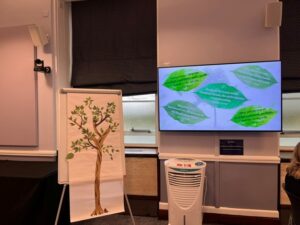 Professor Debra Myhill spoke of the centrality of English in climate education: words, language, and literature are at the heart of empowering young people to articulate their concerns – and joys – in response to the impact of the living world on our lives, the threats climate change brings, and the urgent need for thinking about and acting on sustainability. Debra also spoke of the need for teachers to be given creative spaces to connect and engage with climate education.
Helen Jones gave powerful examples of primary school projects, multimodal responses to the impact of local environmental damage: comics, posters, protests, digital films, and drama. There followed rich discussions on classroom talk about language choices, working with other disciplines and agencies, including the Royal Horticultural Society. Plentiful examples of how our subject encourages debate, creates opportunities for students to cultivate and ‘grow’ their sense of agency and voice, and importantly how English studies pushes for opposite standpoints to be explored.
Dr Andrea Macrae and Dr Jo Clement spoke of the creative and critical writing domain in English, where children and young people can flourish, discover, imagine, transform and explore their own voices and feelings, using and choosing learned and varied language for expression and critical decision making, informed by alternative perspectives. Andrea spoke of Environmental Humanities as a flourishing area, working alongside AI, where interdisciplinary modules connect to skills, literacy, and employability. AI and the Green economy are two big areas for young people, presenting complex entanglements of different narratives for us to work with. We then moved on to explore the need to express who we are away from consumerist culture, and we noted the profound loss to humanity as we witness the demise of many languages, other cultures and perspectives disappearing.
Jo gave examples of using archive material with children in primary school, to encourage curiosity. Memorably her reference to a ‘found’ plate she discovered in a museum, upon which was written “You and I are earth” which captures the essence of the educators’ message. She urged educators to make contact with poets, and bring them into schools and colleges. Reprising Brecht she concluded with ‘Bring the light to children, sing in these dark times’:
In the dark times
Will there also be singing?
Yes, there will also be singing.
About the dark times.
Celebration of the new EA Fellows
This was a joyous moment in which to applaud the contributions from outstanding people within English Studies, across all sectors, and those working in external agencies that promote and develop the work in English Studies. You can explore all our new Fellows on the Fellows webpage.
 Lunch and networking opportunities gave time also to explore our exhibition, including the English 4-11 Picture Book Award winners, the Betty Haigh Shakespeare Prize winner, the Beatrice White Prize winner, and also meet our sponsors.
The Chair and CEO Address
Professor Jennifer Richards, Chair of the EA, opened her address by referencing our esteemed colleague Stefan Collini and the recent publication of his book Literature and Learning: A History of English Studies in Britain, in which you will find a most welcome chapter dedicated to the English Association. Jenny acknowledged and appreciated the work of our volunteers who provide the critical underpinning of the organisation. She commented that our mission remains unchanged since 1906: we are a cross-sector connector. She summed up key aspects of our current work that is about scaling up and joining up: dynamic programme of CPD webinars, Skills project work, our Thinking Forwards programme, and important advocacy work, including resources, for our subject. She reminded us that, as a respondent to the State of the Subject survey put it, “our subject needs some swagger” and the EA is working on this!
Dr Rebecca Fisher, CEO of the EA, gave a brief outline of further work and thinking ahead, reminding us that since 2010 the curriculum and assessment reform process has been on our radar. We have been working with the drafting process of the new Programmes of Study with the Department for Education, bringing diverse voices together in consultative forums. She added that, in response to recent engagement with members, AI and the value of human judgment will be our theme for next year: we will “lead on the ethical, critical and creative” as our Trustee Cassie Martin so aptly puts it in our position paper on AI.
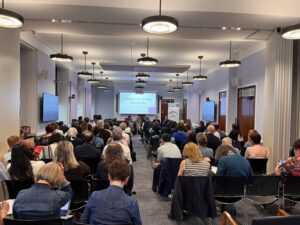 Plenary 2: Shaping the Future of English
Professor Bob Eaglestone chaired an enthusiastic and highly animated discussion on the panel and with the wider audience about the future directions, potential and actual, of our subject. There were positives to celebrate, and challenges outlined and explored.
He opened by highlighting 5 key areas of risk and opportunity that shape our subject:
- The Level 1 qualification (see the EA’s response to the public consultation)
- The GCSEs are the crux of damage to our subject – the EA will work with sister organisations to run workshops to support colleagues to respond to the public consultation on the new National Curriculum in the autumn
- Pedagogies that conflict with the nature of English (for more on this, see our webinar on robust research that proves student peer interaction leads to better GCSE outcomes for English)
- 2026 as the Year of Reading and/but we need to distinguish more between English and literacy
- Accountability measures and pressures on teachers
Each speaker was then invited to add to the discussion:
Kirstie Hewett responded to the NLT’s Children and young people’s reading in 2026 report. She commented on concerns raised by the data (e.g. the decline in boys reading and writing). She spoke of the need to explore further around perceptions of relevance and choice, agency, volitional reading, joy and purpose. She spoke of reading as being curiosity-driven, reading for knowledge, reading about what people care about, learning about the world and human connection. She emphasised that human connection comes first and should be championed, that a critical component of English is fundamentally this: making meaning and connection.
Dr Tom F. Wright addressed the Oracy agenda. There is currently a “moment of affirmation” as Oracy was named as a priority in the CAR. We are developing a shared language to talk about Oracy and no longer at the ‘why’ but at the ‘how’ stage. He noted that spoken language expertise needs to be at the heart of the conversation and we need those who understand language to be centrally involved. He also posed the challenging question: what does speaking and listening look like in Higher Education? He argued that the use of Oracy makes the case for English and that lifelong learning is the future of Oracy; it’s bigger than formal education. He spoke of “community, communication, curiosity” as the new 3 Cs that encapsulate English. He added “Articulacy is cool”, as is learning to disagree eg with teachers.
Professor Katherine Baxter provided an HE perspective and she spoke on the challenges faced on a practical level due to the gradual decline in applications. She referenced the BA report on SHAPE. She posed questions on how we respond and adapt to AI: we need an embedded quality of how we learn and know things as distinct from a computer/ AI doing it for us; how do we steward our discipline into the future? She suggested the way forward is in collaboration, having cross- sector joined up conversations, across subject associations, to work effectively and support our subject. She spoke on thinking about the pipeline, and making proactive moves in our community to lobby and get to the heart of decision making at Westminster.
This led on to Professor Jenny Richards opening with the question: what can you do with an English degree? She continued by summarising the cross-sector work of the EA to answer this question. She spoke of our collaborative work with the British Academy, CRASSH, Skills Builder, Anglia Ruskin University, and colleagues in STEM. The focus of these different projects and collaborations is to get understandings at a granular level, from a variety of perspectives across education, careers advisors, employers, so that we can answer questions around the particular value and contributions of Arts and Humanities with greater precision, with convincing case studies and examples. We need to get to grips with the employability and the AI narratives. Human judgement and human intelligence needs to be explored from different perspectives: dialogue is key and she underlined this is slow work.
There followed further engaging discussion, around the recent Milburn report, the need for the inclusion of adult education in debate, and the need for a rethink in our relationship to lifelong learning.
 To conclude our conference we were transported to the wonderful world of poets and poetry. Susannah Dickey, author of ISDAL and the winner of the 2025 Michael Murphy Memorial Poetry Prize, gave us a tour de force reading from ISDAL. This was then followed by a highly engaging, entertaining, and witty interview with Professor Deryn Rees-Jones, lead judge of the Prize. Unforgettable.