This page provides an overview of current data on student enrolments for English studies. Drawing on published data from external sources, and our own research, the English Association aims to offer a snapshot of current trends to inform practitioners, policy-makers, and other interested parties.
This page is under development and we plan to expand it in due course to cover other sources of data. For queries and/or suggestions for relevant information that might be included, please contact the EA. This page was last updated in August 2025.
1. A-level and Higher English Numbers
Numbers of students choosing to take secondary qualifications are a crucial indicator for English Studies at all levels. Over recent years they have been strongly indicative of trends in University enrolment.
Data on A Level entries in England, Wales, and Northern Ireland are collected by the Joint Council for Qualifications and also published by the Department for Education. Disaggregated data on entries for the three qualifications ‘English Literature’, ‘English Language’ and ‘English Language and Literature’ are available since 2017.

Between 2023 and 2024 overall entries increased from 57,489 to 60,706 (c.5.6%) before falling in 2025 to 57,939. Combining the figures for all three qualifications shows that English is the fifth most popular subject at A-level.
English Literature remains the most popular of the three qualifications and around 65% of total entries for English are for this A-level. Numbers have increased in recent years since a low in 2022, with a slight decrease in the most recent year (c. 4%).
Entries to A-level English Language have decreased every year since 2020, and by 2025 were 15% lower than in 2020. They now represent 22% of total entries in English. Entries in A-level English Language & Literature have seen less significant decreases (8% between 2020 and 2025) but this remain the least widely taken of the three qualifications (around 13% of the combined total)
Increases for A-level English Literature in 2023 and 2024, and for overall English A-level entries in 2024, were particularly welcome given the significant long-term decline in entries to English A-levels, which had fallen from 78,647 in 2017 to 57,489 in 2023 before the most recent rise. The most drastic drops are recorded in 2018 and 2019, with numbers increasing slightly between 2019 and 2020. As of 2025 figures for combined A-level entries are at about 74% of their level in 2017, reflecting similar patterns for other arts and humanities A-levels.
The equivalent qualifications in Scotland are Higher and Advanced Higher English. Data on entries and attainment is published by the Scottish Qualifications Authority. This chart shows entries to these qualifications since 2016, which have been significantly more stable than entries to A-level.

Provisional entry numbers for 2025, released by the SQA in July, show an increase in both Higher (37,130, up by c. 2% from 36,300) and Advanced Higher (3,080 from 2,990, c. 3%) entries compared to 2024.
Comparisons with other subjects in the arts and humanities can be made via the data presented on the British Academy’s SHAPE observatory webpages.
2. Undergraduate English Intakes
Authoritative data on Higher Education enrolments is available from HESA (see 3.) however there is often a considerable time lag in publication. Data on applications to study made via UCAS provides an alternative source for indicative information on undergraduate intakes and sector trends.
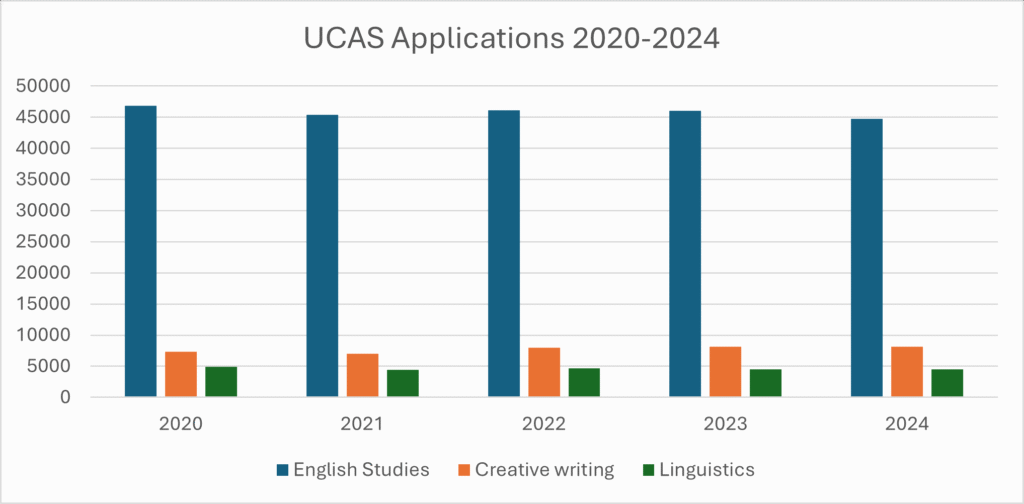
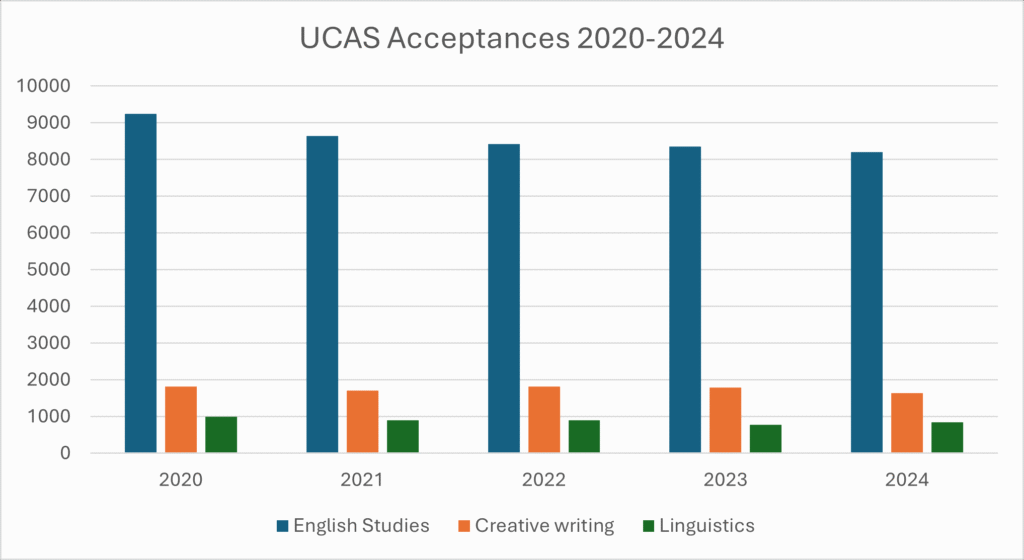
Number of UCAS acceptances for English Studies have seen slight decreases each year since 2021 (8,710 placed applicants) with around 8,205 applicants placed in 2024. Applications rose slightly between 2022 and 2023 but fell in 2024.
Because of the complicated ways in which English Studies degrees are classified (see 4.) it is important to be specific about how the data is being aggregated. These charts distinguish ‘English Studies’ from ‘Creative Writing’ and ‘Linguistics’. ‘English Studies’ is an aggregate of data for ‘English Studies (non-specific)’, ‘English language’, ‘literature in English’ and the small numbers of applications for ‘others in English studies’. NB. however that the majority of courses classified as ‘others in English studies’ are those in ‘British Sign Language’. Courses classified as ‘English language’ include ‘English as a Second Language’.
3. Higher Education Student Numbers
Data on student numbers at tertiary level in the UK is collected by the Higher Education Statistics Agency, now part of JISC. The most recently available data is from the academic year 2023/24. Data for 2024/25 is not expected to be available until spring 2026.
HESA open data contains information on the total numbers of enrolments for different subjects which can be analysed by level of study (e.g. UG, PGT), mode of study (full or part-time), and first-year marker.
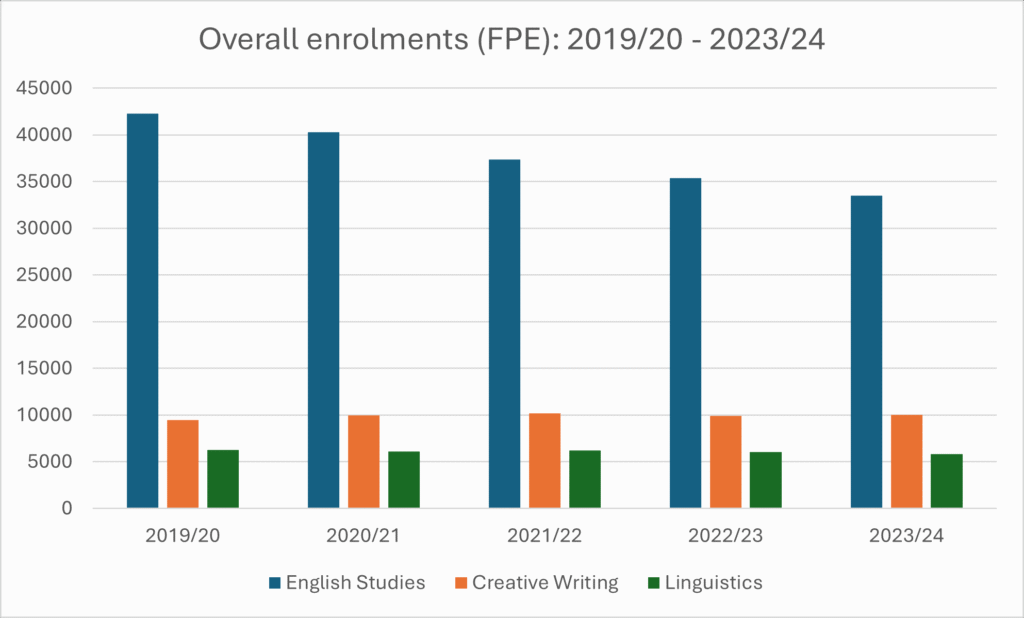
This chart distinguishes overall student numbers for English Studies from those for Creative Writing and Linguistics. It shows that between 2022/23 and 2023/24 English Studies numbers overall have decreased from 35,410 to 33,515, while numbers for Creative Writing have increased slightly from 9,915 to 10,050. The overall trend reflects decreases in both undergraduate first degree and postgraduate (taught) degree numbers for English Studies and Linguistics. Undergraduate first degree numbers for Creative Writing have risen while postgraduate (taught) numbers have fallen.
After seeing an increase between 2021/22 and 2022/23 numbers entering undergraduate first degrees have fallen (from 12,485 to 11,860). While entrants to all Creative Writing have increased, those to English Studies and Linguistics have fallen.
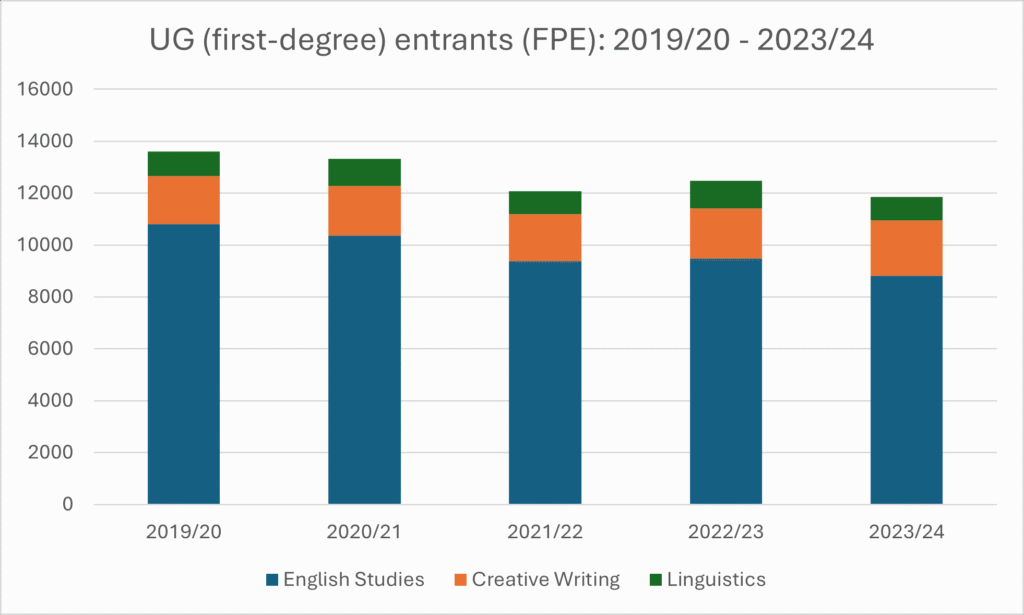
The last two years 2021/22 and 2022/23 have seen a downturn in enrolments for postgraduate taught degrees in English Studies and Creative Writing, reversing recent trends. Since 2022/23 PGT enrolments for Creative Writing are now higher than those for English Studies.
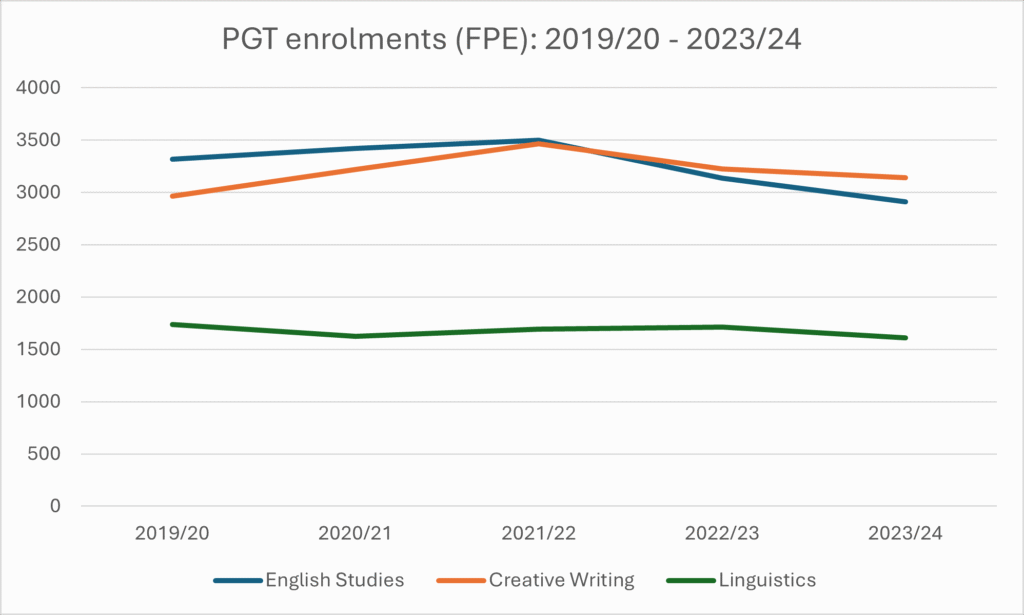 English Studies for this analysis is defined by the English Association as including English Language, Literature in English and English Studies (non-specific), but exclusive of English as a Second Language. Creative Writing figures exclude those for Professional Writing and Scriptwriting.
4. Note on classification of Higher Education subjects of study
HESA data on subject of study can be analysed using HECOS codes (the most detailed classification) or by Common Aggregation Hierarchy (CAH) codes, which group the more granular HECOS categories together. English is classified within ‘19 Language and Area Studies’ and appears to have its own clearly defined sub-division within the CAH level 2 classification: 19-01 English Studies. However this can be misleading. English Studies is further sub-divided into seven CAH level 3 headings which group together courses with a wide range of HECOS codes, some of which might be taught in different departments, and which may not in all contexts be understood as part of English Studies. When working with HESA data it is worth bearing this in mind.
CAH level 3 classification
- 19-01-01 English studies (non-specific): over 27% of the total. Cannot be analysed further as there is only one underlying HECOS code and includes students of both English language and English literature.
- 19-01-02 English language: nearly 12% of the total; NB: 25% of students in this category are studying ‘English as a second language’.
- 19-01-03 Literature in English: about 30% of the total. Most UG courses are not further categorised, however some postgraduate courses are mapped to more specific HECOS codes.
- 19-01-04 Studies of specific authors: 0.3% of the total, mostly used for specialist postgraduate taught courses.
- 19-01-05 Creative Writing: about 20% of the total NB: includes ‘Scriptwriting’, ‘Professional Writing’.
- 19-01-06 Others in English Studies: 0.5% of the total, largely students of ‘British Sign Language’.
- 19-01-07 Linguistics: about 11% of the total.
5. English Association concerns about HE data
The English Association has long been concerned about the misleading classification of English Studies in Higher Education by providers and sector agencies and urges caution in relation to the analysis of published data. Specifically:
- Providers vary in their classifications. Courses coded as ‘English Studies (non-specific)’ may include those which focus on or combine study of ‘English language’ and ‘literature in English’. Consequently the English Association does not believe that comparison or contrast of trends between these three level 3 classifications is reliable.
- The English Association also advises caution with regards to the inclusion of ‘English as a Second Language’ within ‘19-01-02 English Language’. ‘English as a Second Language’ courses can be expected to have very different student demographics (high proportions of non-EU international enrolments) compared to other areas of undergraduate English studies.
We are currently undertaking a project with the SUMS consultancy, in collaboration with University English, the Institute for English Studies, the University of Newcastle, the University of Reading and the University of Edinburgh, to improve provision of data for English Studies, and which will allow us to explore trends in more detail.
The English Association will hold a briefing for its members on English Studies data in 2024/25.
Alex Thomson, Deputy Chair, English Association
Updated: 12 August 2025