Contents
Boys don’t do English: Gender and A Level English
Rachel Roberts
A Numbers Game
It has long been recognised that there is an issue with boys and English. Ofsted’s declaration that ‘across all phases, girls continue to outperform boys in English’[1] indicates less positive outcomes for boys studying English, and their noticeable absence in post-16 English courses.
Although there has been a slight increase in A Level English entries for 2024 – 60670 compared to 57489 in 2023 [2] – when broken down by gender it is clear that male students tend not to opt for English.
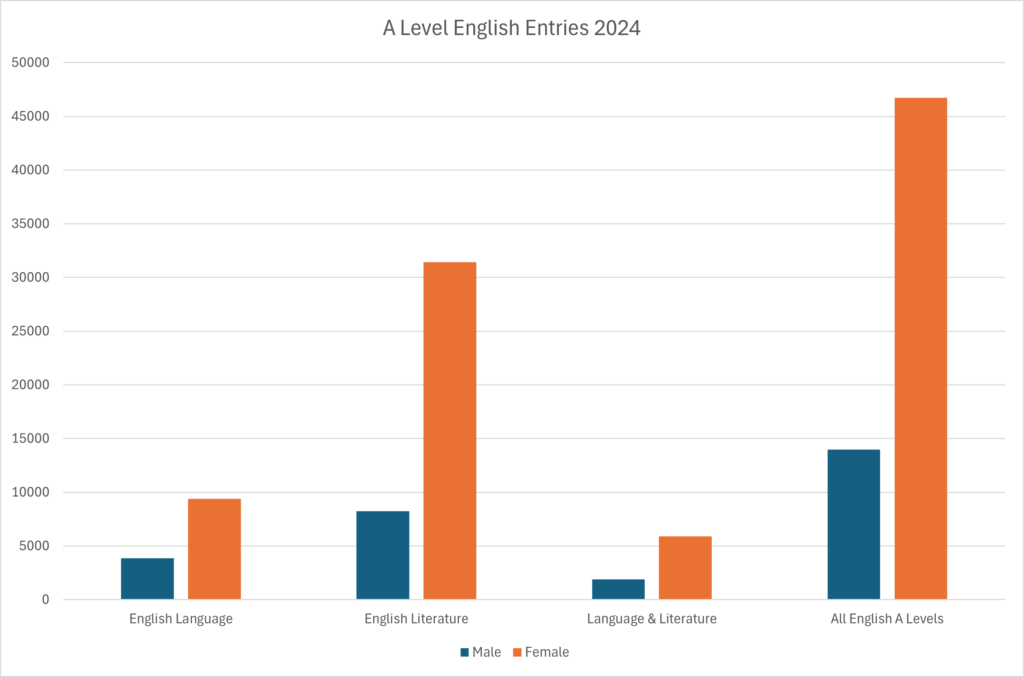
Figure 1 A Level English Entries 2024 by Gender [3]
That male candidates make up only 23% of all A Level Englishes is not new; lower proportions of males taking English has been reported for years.[4]
Different For Boys
Boys tend to favour STEM subjects. Maths is the most popular A Level choice for boys – 67000 entries in 2024, followed by physics and economics.[5] English Literature does not even make the top ten: just 8247 entries last year rank it sixteenth in the choice of A Levels. There is a marked, ongoing gender bias in subject choice. Girls are more likely to opt for social science, humanities and arts subjects than their male counterparts.[6] Not only are male students proportionally less likely to choose an English A-Level, the ‘number of male students has fallen more sharply’,[7] suggesting that things are getting worse. So, why aren’t boys taking English?
The Dominance of STEM
For several years now a key focus of policy has been the importance of STEM subjects and their economic value.[8] This emphasis seems to have seeped into general attitudes towards arts and humanities subjects having lesser value.
Boys’ attitude to English appears to be rooted early in their schooling. A report on 10,000 Yr 11 students’ attitudes to STEM subjects found that boys were more likely to rank STEM subjects [9] as ones they were better at, found most enjoyable, and were most likely to lead to a highly-paid job in the future. A recent study similarly found that boys enjoy English less than girls, and were more likely to enjoy maths and science than girls: ‘the enjoyment of STEM subjects is clearly stratified by gender before the end of primary schooling’.[10] What’s influencing this appears to be ‘cultural environment and stereotypes.’[11]
A Level Choice Influences
Speculation about the decrease in English A Level numbers has ranged from the impact of the current GCSE curriculum [12] to the prospective high costs of going to university.[13] This is largely corroborated by empirical data. My own research has found that core influences on A Level choices were family, teachers, peers, and being a ‘reader’.[14] Similarly, of the 107 male A Level English respondents of a 2023 survey,[15] the majority indicated that their experience of English at KS4, quality of teaching, and future career plans were the most influential in their decision to take English. The negative perceptions of English and its value were apparent even for the students who were studying it, with one commenting: ‘My family didn’t want me to choose English as they believed it was worthless compared to maths and science.’ This perception was linked to another common misconception that ‘not many successful career positions… can be gained in English’.
Davies & Ercolani [16] suggest that ‘boys express a much stronger motivation towards private financial gain whilst girls express stronger motivation towards occupational status and contributions towards society’, which would suggest that larger societal influences are at play. English is seen by some, then, as lacking in both intrinsic and extrinsic value.
A ‘Feminised’ Subject
How far is this lack of value connected to a perception that English is a ‘feminine’ subject? In the interviews I conducted with 67 Yr11 and Yr12 students, I was particularly struck by how gendered many of the students felt English is,
…in terms of the teachers (largely female), the students (most of the Yr 12 participants were girls) but also the texts studied and approach to the subject, that it was somehow considered “girly”: ‘I picture girls and I know that might come from a place of internalised misogyny… I don’t really know many boys who are into reading or like writing’ (Yr 11 Student)… Students were aware of the stereotyping that they were being influenced by, but it was clear that they felt some students were put off studying English because it was associated with femininity: ‘People view English as a female subject and therefore don’t take it’ (Yr12 Student) [17]
If boys are put off English because there are negative connotations of what might constitute stereotyped and highly reductive views of masculinity and femininity, then a much wider conversation about what we value in school curricula is urgently needed.
Attempting to make English more ‘boy-friendly’ by, perhaps, making textual choices that might be considered to align more with ‘male’ interests is a fallacy and would not actually address these issues.[18] Newman’s case study of a school where A-Level English literature was a very popular choice for male students appeared to address the issue of value directly: English and the arts has a high profile throughout the school and the social and socio-economic context of the school meant that they had ‘male role models in their lives for whom the skills taught in English provide strong cultural capital (Bourdieu, 1977) and from which they derive their livelihood…[English] is held in high esteem precisely because they perceive it to be relevant in their future careers’.[19] Ofsted’s 2003 report on schools in which boys were highly successful, argued that school culture needed to be
“non-macho”, with intellectual, cultural and aesthetic accomplishment by boys expected and accepted… [with] powerful male role models, particularly teachers whose enthusiasm for literature, drama, music and the discussion of ideas set a standard in the school for pupils to aspire to.[20]
Success is likely to breed success.
Suggestions for improving boys’ engagement and achievement in English from Ofsted and English specialists highlight features of good teaching: making writing tasks purposeful, value being placed on a diversity of style in written work, written tasks tackled in stages, with regular feedback [21]; explicit instruction and positive reinforcement.[22]
A better focus for policy makers would be to tackle some of the misconceptions about what English can do for students in terms of their personal and emotional development [23] and to be clear about the career opportunities and remuneration to which the study of English can lead.[24] Even better would be to address the inequality of value placed on arts and humanities; therein lies the rub.
[1] Ofsted, Moving English Forward (London: Ofsted, 2012), p. 5.
[2] Joint Council for Qualifications (JCQ), AS and A Level Results Summer 2024 (2024) https://www.jcq.org.uk/wp-content/uploads/2025/01/AS-and-A-level-results-summer-2024.pdf [accessed 17 February 2025]
[3] JCQ, AS and A Level Results Summer 2024
[4] Mary Curnock Cook, English is now a Modern Foreign Language for boys; Physics is a foreign language for girls too: Grades aside, what do this year’s A level entry trends tell us? (2020) https://www.hepi.ac.uk/2020/09/01/english-is-now-a-modern-foreign-language-for-boys-physics-is-a-foreign-language-for-girls-too-grades-aside-what-do-this-years-a-level-entry-trends-tell-us/ [accessed 16 February 2025]
[5] JCQ, AS and A Level Results Summer 2024.
[6] Natasha Plaister, Why aren’t students choosing to study English and the arts at A-Level?: Part one. (2021) https://ffteducationdatalab.org.uk/2021/10/why-arent-students-choosing-to-study-english-and-the-arts-at-a-level-part-one/#:~:text=Which%20students%20have%20stopped%20choosing,English%20A-Level%20than%20others [accessed 16 February 2025]
[7] Natasha Plaister, Why aren’t students choosing to study English and the arts at A-Level?: Part two (2021) https://ffteducationdatalab.org.uk/2021/10/why-arent-students-choosing-to-study-english-and-the-arts-at-a-level-part-two/ [accessed 16 February 2025].
[8] Grainne Hallahan, 6 key trends from the DfE’s new A-level results data (2022). https://www.tes.com/magazine/analysis/secondary/what-can-we-learn-a-level-results-2022-exams-data [accessed 16 February 2025]; Salle Weale and Larsson Pineda, ‘Students don’t see the value’: why A-level English is in decline (2019) https://www.theguardian.com/education/2019/aug/16/students-dont-see-value-a-level-english-decline#:~:text=English%20lessons%20went%20from%20being,The%20atmosphere%20was%20fantastic.%E2%80%9D [accessed 16 February 2025].
[9] Department for Education, Attitudes towards STEM subjects by gender at KS4 (2019) https://www.gov.uk/government/publications/attitudes-to-stem-subjects-by-gender-at-key-stage-4 [accessed 16 February 2025].
[10] Sarah Stopforth, Roxanne Connelly, Vernon Gale, ‘Do you like school? Social class, gender, ethnicity and pupils’ educational enjoyment’, The British Journal of Sociology, 75.4 (2024), 535-553, p. 547.
[11] Chiara Cavaglia, Stephen Machin, Sandra McNally, Jenifer Ruiz-Valenzuela, ‘Gender, achievement, and subject choice in English education’, Oxford Review of Economic Policy, 36.4 (2020), 816-835, p. 15.
[12] Grainne Hallahan, The slow decline of A-level English and how to halt it (2021) https://www.tes.com/magazine/teaching-learning/secondary/slow-decline-level-english-and-how-halt-it [accessed 17 February 2025]
[13] Weale and Larrson Pineda, ‘Students don’t see the value’: why A-level English is in decline (2019).
[14] Rachel Roberts, ‘The Decline and Fall (?) of A Level English’, Teaching English, 34 (2024), 39-43.
[15] Furzeen Ahmed, Marcello Giovanelli, Rachel Roberts, ‘Reasons for Doing English Project’, (2023) https://x.com/ReasonsDoingEng [accessed 17 February 2025]
[16] Peter Davies and Marco G. Ercolani, ‘Gender, motivation and labour market beliefs in higher education choices’, Higher Education, 82 (2021), 127-144, p. 127.
[17] Roberts, ‘The Decline and Fall (?) of A Level English’, 2024, p. 42.
[18] Ofsted, Yes he can: schools where boys write well, (London: Ofsted, 2003); Matt Pinkett and Mark Roberts, Boys Don’t Try? (Abingdon: Routledge, 2019).
[19] Elise Newman, ‘Lads and English’, English in Education, 39.1 (2005), 32-42, p. 35.
[20] Ofsted, Yes he can: schools where boys write well (2003), p. 7.
[21] Ibid.
[22] Mark Roberts, The Boy Question: How to Teach Boys to Succeed in School, (Abingdon: Routledge, 2021).
[23] Ofsted, Moving English Forward (2012).
[24] Valentina Rampino and Mark Taylor, Subject of Degree and Graduate Earnings: The Signalling Power of Higher Education (London: Institute for Social and Economic Research, 2013), p. 35; University English, The Value of Studying English (London: University English, 2024).
References
Ahmed, F., M. Giovanelli, and R. Roberts, Reasons for Doing English (2023) https://x.com/ReasonsDoingEng [accessed 17 February 2025]
Cavaglia, C., S. Machin, S. McNally, and J. Ruiz-Valenzuela, Gender, Achievement, and Subject Choice in English Education (London: Centre for Vocational Education Research, 2020)
Cook, M., ‘English is Now a Modern Foreign Language for Boys…’, HEPI (1 September 2020) https://www.hepi.ac.uk/2020/09/01/english-is-now-a-modern-foreign-language-for-boys-physics-is-a-foreign-language-for-girls-too-grades-aside-what-do-this-years-a-level-entry-trends-tell-us/ [accessed 16 February 2025]
Davies, P., and M. Ercolani, ‘Gender, Motivation and Labour Market Beliefs in Higher Education Choices’, Higher Education, 81 (2021), 127–144
Department for Education, Attitudes Towards STEM Subjects by Gender at KS4 (London: DfE, 2019) https://www.gov.uk/government/publications/attitudes-to-stem-subjects-by-gender-at-key-stage-4 [accessed 16 February 2025]
Hallahan, G., ‘The Slow Decline of A-Level English – And How to Halt It’, TES (31 August 2021) https://www.tes.com/magazine/teaching-learning/secondary/slow-decline-level-english-and-how-halt-it [accessed 17 February 2025]
Hallahan, G., ‘What Can We Learn from A-Level Results 2022?’, TES (23 November 2022) https://www.tes.com/magazine/analysis/secondary/what-can-we-learn-a-level-results-2022-exams-data [accessed 16 February 2025]
Joint Council for Qualifications (JCQ), AS and A Level Results Summer 2024 (2024) https://www.jcq.org.uk/wp-content/uploads/2025/01/AS-and-A-level-results-summer-2024.pdf [accessed 17 February 2025]
National Literacy Trust, Children and Young People’s Reading in 2024 (24 October 2024) https://literacytrust.org.uk/research-services/research-reports/children-and-young-peoples-reading-in-2024/ [accessed 7 April 2025]
Newman, E., ‘Lads and English’, English in Education, 39.1 (2005), 32–42
Ofsted, Moving English Forward (London: Ofsted, 2012)
Ofsted, Yes He Can: Schools Where Boys Write Well (London: Ofsted, 2003)
Pinkett, M., and M. Roberts, Boys Don’t Try? (Abingdon: Routledge, 2019)
Plaister, N., ‘Why Aren’t Students Choosing to Study English and the Arts at A-Level? (Part One)’, FFT Education Datalab (17 September 2021) https://ffteducationdatalab.org.uk/2021/10/why-arent-students-choosing-to-study-english-and-the-arts-at-a-level-part-one/ [accessed 16 February 2025]
Plaister, N., ‘Why Aren’t Students Choosing to Study English and the Arts at A-Level? (Part Two)’, FFT Education Datalab (5 October 2021) https://ffteducationdatalab.org.uk/2021/10/why-arent-students-choosing-to-study-english-and-the-arts-at-a-level-part-one / [accessed 16 February 2025]
Rampino, T., and M. Taylor, Gender Differences in Educational Aspirations and Attitudes (Institute for Social and Economic Research, 2013), SER Working Paper Series, no. 2013‐15
Roberts, M., The Boy Question: How to Teach Boys to Succeed in School (Abingdon: Routledge, 2021)
Roberts, R., ‘The Decline and Fall (?) of A-Level English’, Teaching English, 34 (2024), 39–43
Stopforth, S., R. Connelly, and V. Gayle, ‘Do You Like School? Social Class, Gender, Ethnicity and Pupils’ Educational Enjoyment’, The British Journal of Sociology, 75.4 (2024), 535–553
University English, English Creates Media Toolkit (2024) https://universityenglish.ac.uk/englishcreates-media-toolkit/ [accessed 7 April 2025]
Weale, S., and N. Larsson Pineda, ‘Students Don’t See Value in A-Level English – Decline Explained’, The Guardian (16 August 2019) https://www.theguardian.com/education/2019/aug/16/students-dont-see-value-a-level-english-decline [accessed 7 April 2025]
Rachel Roberts was an English teacher for 10 years before moving into HE; she is now Associate Professor of English Education at the Institute of Education, University of Reading, where she runs the Secondary English PGCE and is Deputy Director of the Secondary PGCE programme. She is former Chair of the National Association for the Teaching of English (NATE), Fellow of the English Association and a member of its Higher Education Committee. Her research interests include mentorship, Initial Teacher Education, L1 English curriculum and pedagogy.